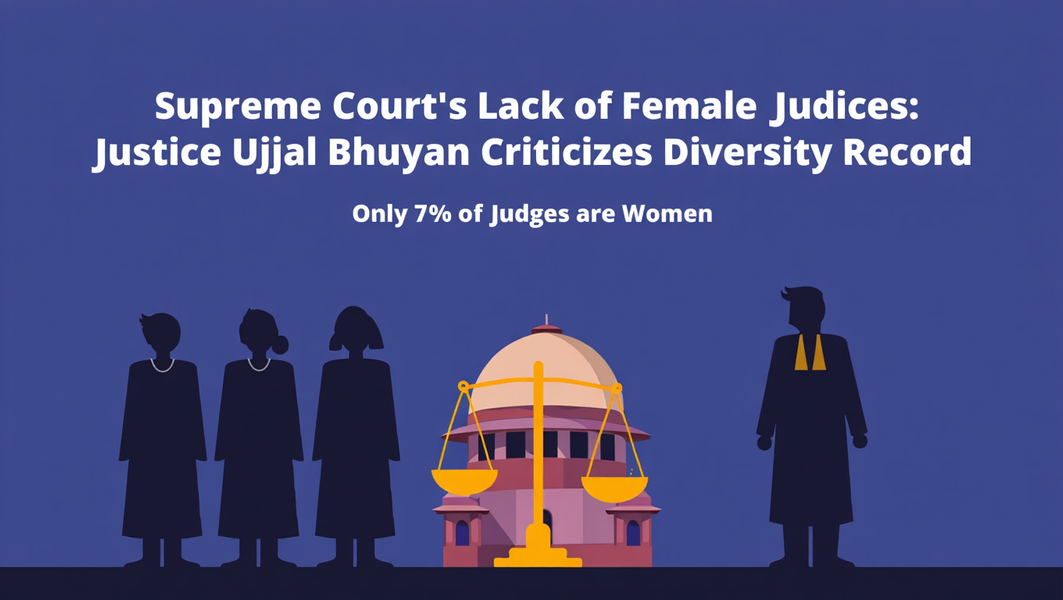
Supreme Court's Lack of Female Judges: Justice Ujjal Bhuyan Criticizes Diversity Record
Cause Title: Indian Women in Law (IWiL) conference
Background
Supreme Court Judge Justice Ujjal Bhuyan recently expressed concern regarding the lack of gender diversity in appointments to the Supreme Court of India, particularly during the tenure of former Chief Justice of India (CJI) D.Y. Chandrachud. Justice Bhuyan highlighted that none of the fourteen judges appointed to the Supreme Court during that period were women, raising important questions about gender representation in the country’s highest judicial institution.
These remarks were made during the Indian Women in Law (IWiL) conference held at the Supreme Court of India, where a session titled “Inclusive Benches – Stronger Justice” examined the broader issue of judicial diversity and representation. The conference brought together judges, legal scholars, and practitioners to discuss the importance of building a judiciary that reflects the diversity of the society it serves.
Judicial diversity has increasingly become a subject of debate in India, particularly in the context of gender representation in higher courts. Although women have made significant progress in entering the legal profession and the district judiciary, their representation in High Courts and the Supreme Court remains comparatively low.
The Indian Constitution emphasizes principles of equality and inclusion, and many experts argue that a diverse judiciary strengthens public confidence in the justice system. Diversity among judges can also contribute to broader perspectives in judicial decision-making, ensuring that courts remain sensitive to the social realities faced by different sections of society.
Justice Bhuyan’s comments therefore sparked renewed discussion about whether the current system of judicial appointments adequately promotes gender diversity in the higher judiciary.
Court’s Observation
During the conference discussion, Justice Ujjal Bhuyan observed that the absence of women among the fourteen judges appointed to the Supreme Court during former CJI D.Y. Chandrachud’s tenure raises concerns about the pace of progress toward gender inclusion in the higher judiciary.
Justice Bhuyan questioned the widely held assumption that increasing numbers of women entering the district judiciary would automatically lead to greater representation of women in higher courts such as the High Courts and the Supreme Court.
Former CJI Chandrachud had previously expressed the view that the growing presence of women in lower judicial services could gradually result in increased representation at higher levels of the judiciary over time.
However, Justice Bhuyan suggested that the situation is more complex and that such a transition is not guaranteed under the current appointment framework.
He explained that most appointments to High Courts are made from the Bar, meaning that many judges are selected from among practicing advocates rather than from the district judiciary. Because of this structure, the increasing number of women entering the district judiciary does not necessarily translate into proportional representation in higher courts.
Justice Bhuyan further observed that women often perform exceptionally well in competitive judicial service examinations, where the selection process is largely objective and based on merit through written tests and interviews.
However, their representation tends to decline at higher levels of the judiciary, particularly in positions where appointments depend on recommendations, professional networks, and Collegium decisions.
These observations highlight structural issues in the judicial appointment process that may inadvertently affect gender representation in higher courts.
Outcome of the Discussion
The remarks were made in the context of a conference discussion rather than a judicial proceeding, and therefore no formal judicial decision or order was issued.
However, Justice Bhuyan’s comments contributed to an important dialogue about institutional reforms and the need for deliberate measures to promote diversity in the judiciary.
Other distinguished panelists at the event, including Justice Anita Sumanth and Justice Hima Kohli, also participated in discussions emphasizing the importance of greater representation of women within the higher judiciary.
The panel collectively explored ways in which judicial institutions and appointment mechanisms could become more inclusive, ensuring that qualified women lawyers and judges have greater opportunities to serve in leadership positions within the judiciary.
Key Points
Several important issues emerged from the discussion:
- Justice Ujjal Bhuyan noted that none of the fourteen judges appointed to the Supreme Court during former CJI D.Y. Chandrachud’s tenure were women.
- He questioned the assumption that increasing representation of women in the district judiciary will automatically lead to greater representation in higher courts.
- A large proportion of High Court judges are appointed directly from the Bar, limiting the pipeline from the district judiciary.
- Women tend to perform well in competitive judicial service examinations, where the selection process is more objective.
- Representation of women declines in higher judicial appointments where recommendations and Collegium decisions play a significant role.
Significance
Justice Bhuyan’s remarks have contributed to the ongoing debate regarding gender diversity and representation in India’s higher judiciary.
A judiciary that reflects the diversity of society can enhance public trust, legitimacy, and fairness in the justice system. Greater representation of women judges can also bring valuable perspectives to legal interpretation, particularly in cases involving gender rights, social justice, and equality.
The discussion at the Indian Women in Law conference highlighted that achieving diversity in the judiciary may require deliberate institutional design and policy measures, rather than relying solely on gradual changes in lower judicial levels.
Legal experts have increasingly emphasized the importance of transparent appointment processes, mentorship opportunities for women lawyers, and conscious efforts by the Collegium and other appointing authorities to promote inclusivity.
Ultimately, the remarks underline the idea that gender diversity is not merely a symbolic goal but an essential component of a robust and representative judicial system.